

10–12
Bids per week Elder’s specialty shop was pricing, with no way to triage them
1 in 5
How often bid feedback comes back, by Elder’s informal read of subcontractor peers
$5M
General liability limit he has seen required on a roughly $100,000 bid
Every Monday, a subcontractor estimator opens an inbox full of invitations to bid. Some come from general contractors they have worked with for a decade. Some come from firms they have never heard of, chasing one job in a market they may never return to. All of them want a number by Thursday.
Ryan Elder has sat on both ends of that transaction. He started his career with a regional general contractor in Colorado, then spent years at Turner Construction in Kansas City as a project engineer, project manager and, finally, purchasing agent. After roughly a decade on the GC side, he opened a specialty subcontracting division inside his family’s facility management business, furnishing and installing Division 10 and 12 scope for ten to twelve years. When that division wound down, he founded BidIntell, a pre-bid intelligence tool built to help subcontractors decide which invitations deserve their limited estimating hours.
His definition of great preconstruction starts where most conversations about it stop: with the business cost of helping.

Precon has a business side, and trade partners carry part of it
Elder describes great precon on two levels. The first is familiar. Every party is there to help the owner reach the project’s goals, whether that means saving money, shortening the schedule or improving the design, and each one fills its own hole in that equation.
The second level gets less airtime. Precon costs money to deliver. General contractors are often paid for their preconstruction services. The trade partners they lean on for budget pricing, constructability input and scope definition usually are not. Those trade partners contribute because they want the project to succeed, want to earn the GC’s confidence, and expect the upfront work to pay off on a future award.
That expectation is a reasonable bet inside a real relationship. Elder’s point is that GCs should acknowledge the bet exists, because the trade partner’s estimating hours are a business expense with a limited budget.
What the buyer sees that the bidder doesn’t
In purchasing at Turner, Elder’s job was to keep a pulse on the subcontractor market. When a project entered preconstruction, purchasing made sure estimators reached the right firms for each scope: who could handle a specialty system, who was already overloaded, and who else could step in.
Vetting subs meant reviewing their financials and signing NDAs to confirm they could carry the work. That was when the business of construction clicked for him. As a project manager, he had assumed bids simply arrived. In purchasing, he saw that every bid represented a firm deciding to spend money on a pursuit.
The stake runs both ways. When a buyer recommends a trade partner for precon and that firm goes quiet, the buyer’s own credibility takes the hit. Responsiveness during precon is part of the relationship, in both directions.
He carried that lesson to the other side. Running his own shop, he treated every precon request as an investment decision, and he wanted the GCs he worked with to treat his time the same way.
Bring specialty trades in at schematic design
Asked when trade partners should join the process, Elder points to schematic design, once the building has a defined structure. Early divisions, from sitework through structural steel, are hard to price on a square-foot basis. Much of the middle of the building can be estimated by unit of measure once quantities exist.
Specialty scope is where experience earns its keep. A wall of windows on a schematic set tells a seasoned buyer the owner will probably want shades, and that the shades may be motorized. An open floor plate in a conference center suggests an operable partition. Neither the wiring nor the steel to support those systems is drawn yet, and often the engineer has not figured them out either. A buyer who knows where those gaps hide can bring in a specialty installer early to price what the drawings do not show.

His shop dealt with these gaps constantly, so over time they trained GCs to involve them earlier. There is a second wrinkle. More specialty manufacturers now sell through certified installers, which narrows the bidding pool for a given product. That helps when the installer knows the system, and it creates trouble when a buyout treats every roller shade or operable wall as interchangeable and the specs say otherwise.
The three-bid habit and the word “partner”
Elder understands why GCs collect multiple bids. Buyers need to validate that a scope is being bought at market price, and public funding often requires competition. On larger jobs, three bids is the floor.
The tension shows up in the language. The industry moved from “subcontractor” to “trade partner” to signal a working relationship. Elder’s view: the partner word gets used a little loosely. When pricing is purely competitive, a sub who spots a scope gap has little reason to flag it, and every reason to price it later as a change order. The partnership version looks different: scope the work together, name the known gaps, and carry contingency or holds for them in the budget.
Plan rooms made distribution nearly free, which created a second problem. Trade partners now receive invitations from out-of-town GCs chasing a single project, sent because a profile lists the right trade. Elder calls that approach odd for a firm that wants a successful project, because it skips the relationship work entirely. When the GC knows nothing about a trade partner beyond a website listing, price becomes the only signal, and that is how a scope turns into a race to the bottom.
“You need my bid. I think I should get a little bit of feedback for providing my bid to you.”
Ryan Elder, Founder, BidIntell
Bid/no-bid is a business decision
Elder is candid about where his own shop went wrong. In specialties, a firm bids more projects than the average trade, and his team was pricing ten to twelve a week across BuildingConnected, PlanHub and Procore invitations with no way to triage them. They had not defined how many jobs they needed to win each month, at what margins, to grow.
Backlog created a second blind spot. The company might carry $2 million in backlog without knowing when that work would hit. Monthly gross margin has to cover more than project managers and estimators. It has to carry office managers, accountants, warehouse staff and everyone else it takes to run the business. After some turnover, the numbers got upside down, and the division closed. Elder helped his team find new jobs.
Those lessons shaped BidIntell. The idea borrows from lead scoring, which most industries take for granted and commercial construction largely lacks. Each incoming invitation gets scored against what the subcontractor says a good job looks like: location fit within a chosen travel radius, history with the client, and trade fit based on CSI spec sections plus keywords found in the drawings. That last piece matters on schematic sets that arrive with notes and no specs.
The weights are adjustable. A firm that stays inside its metro can let location dominate. A firm that only wants to work with proven clients can weight relationship history. A firm chasing healthcare can rank those projects above a public school.
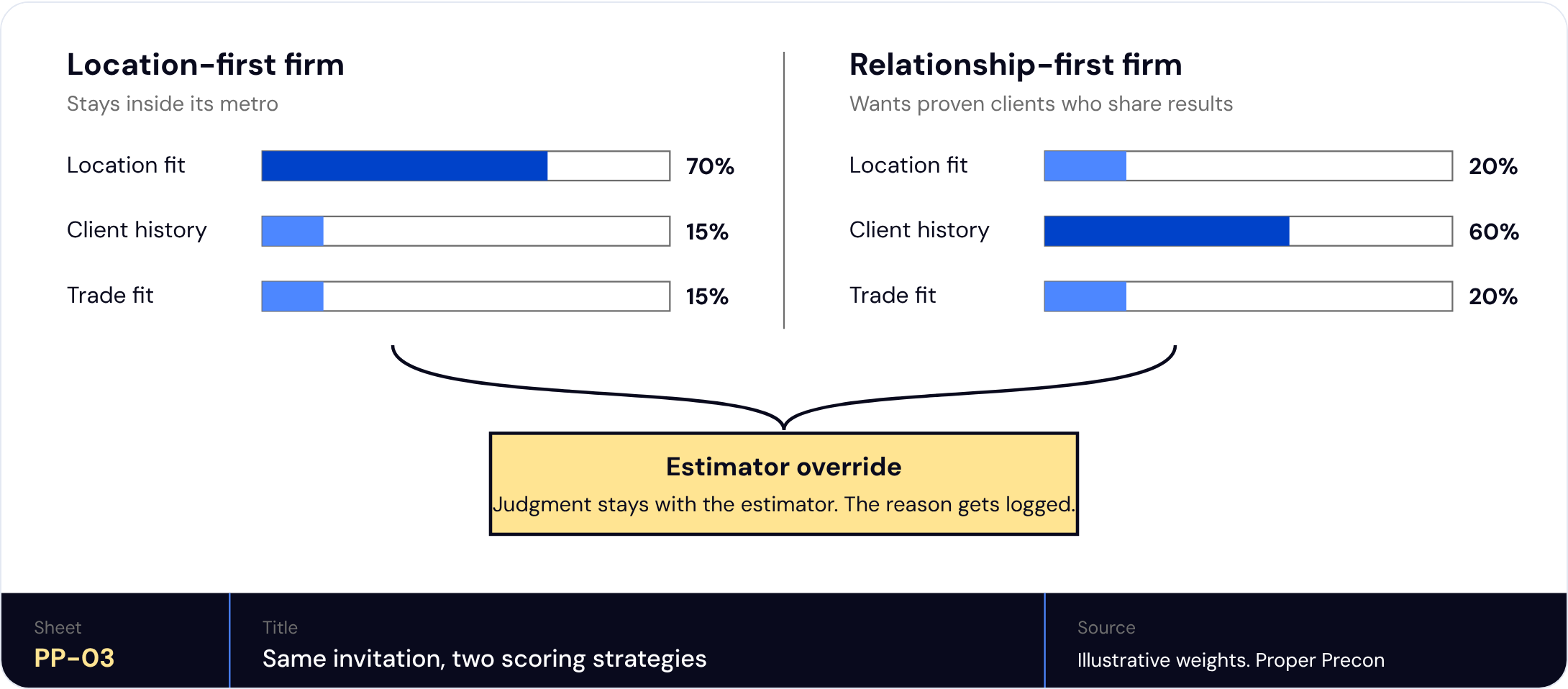
Estimators can override any score and add comments, and every outcome gets logged. Elder is clear that the tool supports judgment rather than replacing it: “We’re not the Tesla yet. We’re not on full autopilot.” Plenty of what an experienced estimator knows about a client or a market never shows up in a document.
That logging solves a quieter problem too. In many trade firms, decades of bidding knowledge live in one chief estimator’s head. Capturing why a job was pursued or declined lets a newer estimator learn the firm’s logic, and lets the chief estimator take a vacation without bids slipping.
What useful bid feedback looks like
Asked for the one thing he would change about how GCs and trade partners work together, Elder did not hesitate: feedback. Trade partners are bidding to stay in business, build relationships and win work. Honest results, good or bad, help them improve. In his experience, feedback builds in three layers.
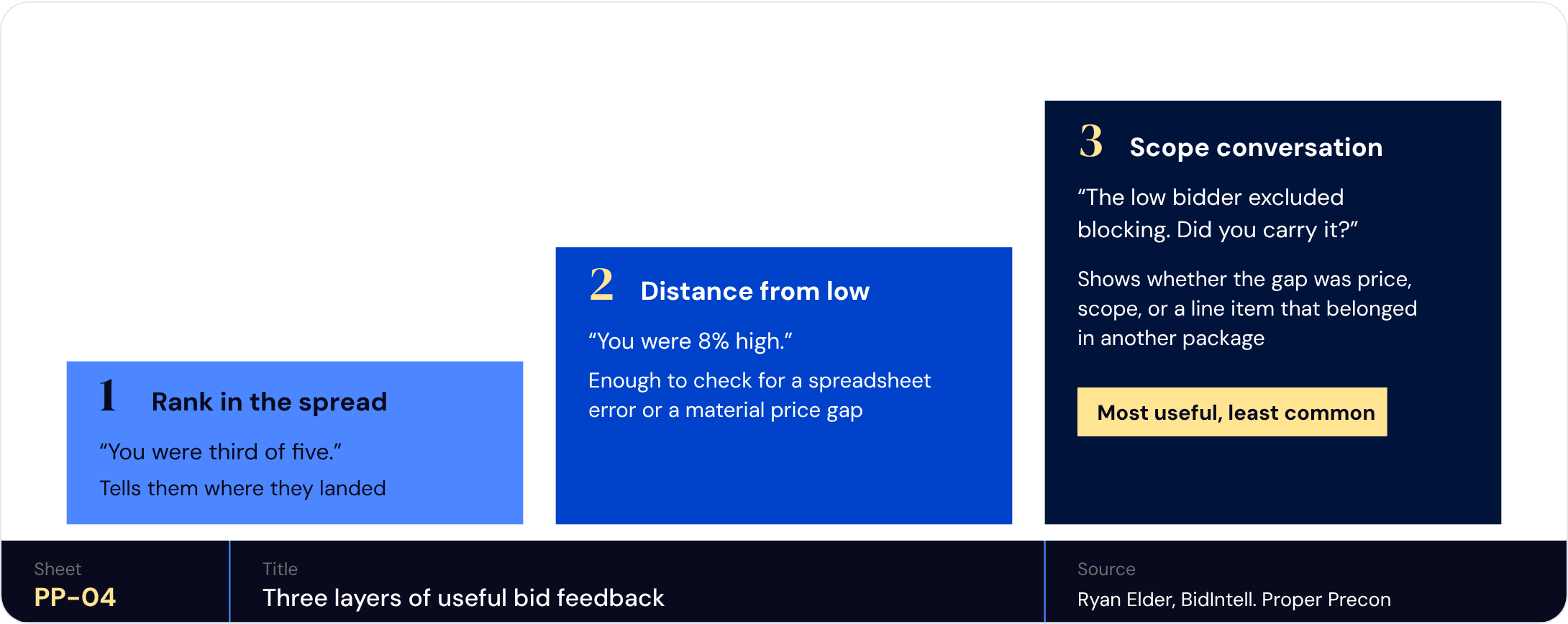
The first two layers take a minute and an email. The third takes a phone call, and Elder considers it something of a lost art. The numbers help; the conversation helps more.
Feedback also has to run the other direction. The behavior that frustrates GCs most, in Elder’s view, is a trade partner who goes unresponsive, usually because the firm took on more pursuits than it can handle. A firm that declines on purpose has more capacity to answer the calls it does take.
Shared risk shows up in the contract
Partnership gets tested after the award. Deposits were a recurring pain point for Elder’s shop. Specialty manufacturers increasingly want money up front, and a subcontractor should not have to finance the project. Over time his team coached GCs to accept deposits and gave them the information to coach their owners in turn. Public work adds rules that compound the problem: materials that cannot be billed until they are on site, and storage restrictions that push orders later, often past the window for locking a price.
Payment technology has helped. Elder points to accelerated payment programs some large GCs offer, where a trade partner trades a small discount for payment in about 30 days instead of 70. Project management platforms are more mixed. When fifty GCs configure the same tool fifty ways, a trade partner has to remember which client uses which module before finding a schedule.
Takeaways for both sides of the buyout
For general contractors
- Send a scope sheet ahead of the bid.
Elder calls it the most underrated part of a good bid package. - Curate invitations.
A shorter list of firms you know gives you better pricing input than a mass send. - Give feedback in layers.
Rank, percentage from low, and a short scope conversation. - Right-size the paperwork.
Match insurance requirements to the scope value, and plan for deposits on specialty products.
For trade partners
- Set targets before the invitations arrive.
How many jobs you need to win, and at what margins. - Score every invitation against your own strategy.
Log why you pursued or passed. - Track win rates and feedback by client.
So the next decision rests on evidence. - Answer the calls you take on.
Responsiveness during precon is your reputation with the buyer.
Looking ahead: off-site construction
Asked what precon teams will need to figure out over the next five years, Elder pointed to off-site construction. Prefabricated MEP racks have been around for years, and manufacturers now ship complete patient rooms, exam rooms, hotel rooms and detention cells. Factory labor costs less, the controlled environment helps quality, and fewer trades compete for the crane on site. With labor shortages everywhere, he sees off-site as one of the more practical answers available, provided the owner is willing to have the upfront conversations it requires.
Those conversations bring the argument back to precon. Off-site work rewards teams that define scope early, involve the right trades at the right moment and share information freely. That describes the GC and trade partner relationship Elder wants to see on every project.
Frequently asked questions
When should trade partners get involved in preconstruction?
For most projects, schematic design is the practical entry point, once the building’s structure is defined. Specialty scopes like motorized shades and operable partitions benefit most from early involvement, because the support steel and wiring they need usually are not drawn yet.
What should a general contractor’s bid feedback include?
Useful feedback has three layers: where the bid landed in the spread, how far it was from the low number as a percentage, and a short scope conversation about what the low bidder carried or excluded compared with your number.
How should a subcontractor decide whether to bid a project?
Treat it as a capacity decision. Weigh location fit, your history with the client, and how well the scope matches your trade, then compare the opportunity against the estimating hours and margin targets your business needs. Log outcomes so the decision gets sharper over time.
Why do general contractors ask for three bids?
Multiple bids validate that a scope is being bought at a market price, and public funding often requires competition. The tradeoff is that pure price competition can discourage trade partners from flagging scope gaps during precon.
What are red flags in a bid invitation?
Common red flags include insurance limits far out of proportion to the scope value, an unfamiliar or out-of-market general contractor, no scope sheet, and a client with a history of never sharing results.
The takeaway
Precon is not free for the people who make it work. Trade partners spend real estimating hours on budgets and scope input, usually unpaid, as a bet on a future award. The GC’s side of that bet is curation and feedback: invite firms you know, send a scope sheet, and tell bidders where they landed and why. The trade partner’s side is discipline: decide which invitations deserve a number, log the reason either way, and answer the calls you take. Get both right and the bid you decline can be the smartest one you make.
Better buyout starts with a better estimate
Ediphi gives precon teams one live cost model, so scope, holds and trade pricing stay connected from schematic design through buyout.


