

95%
of enterprise AI investments report zero ROI — because the underlying data isn't structured
3 wks
How long pre-construction took for the Empire State Building. Today, it takes years.
5 of 20
ENR Top 20 GCs now standardized on Ediphi as their pre-construction platform
In front of 300 construction professionals gathered in Vancouver for Precon 2026, Ediphi founder and CEO Dustin Devan opened the day with a challenge: the construction industry has more data than ever, and almost no way to use it.
The keynote, titled "Unlocking the Power of Your Pricing Data," traced a path from where the industry is today — fragmented systems, reactive estimating, and clients who routinely get 50% sticker shock on their first cost plans — to where it needs to go: a world where general contractors are the first call an owner makes, not the last.
The Real Reason AI Isn't Working in Construction
Devan opened with a blunt observation: the construction industry has spent billions chasing AI ROI and landed almost nothing. An MIT study found 95% of enterprise AI investments produced zero measurable return. His diagnosis wasn't that AI is overhyped — it's that the data it needs to operate doesn't exist in a usable form.
"We have so much project data over all these years. Yeah. How do you actually use it to get better on each job? Not a lot of people have good answers."
Dustin Devan, Founder & CEO, Ediphi
The problem isn't access to data. Every GC has project history. The problem is that data lives across spreadsheets, estimating tools, bid platforms, VE management tools, model coordination software, and GC/GR systems — all disconnected, all formatted differently, none of it speaking to anything else.
The result: estimating stays artisanal. Every project starts mostly from scratch. AI has nothing coherent to learn from.

The Morphine Problem
Devan put the industry's technology habits in terms that landed: most pre-construction teams are running into the ER with a gunshot wound and asking for morphine. The pain goes away temporarily — another software layer, another integration, another tool. But nobody is taking out the bullet.
"Layering on additional tools until we have cost infrastructure in our organizations is not going to effectively solve the problem."
Dustin Devan, Founder & CEO, Ediphi
The bullet is this: construction lacks a unified cost infrastructure that captures not just what things cost, but why, in what context, at what design stage, and what decisions drove the number. Without that, every estimate starts from intuition rather than institutional memory. Every AI tool has no real foundation to build on.
The Estimating Gap Nobody Talks About
Devan identified a specific failure mode that plays out on almost every project: the gap between conceptual estimating and detailed estimating. GC teams are competent at both ends of the spectrum. At 100% CDs, they can quantify everything. With a handful of benchmark projects, they can put together rough comparisons. But in between, the estimating process gets thin fast.
The result shows up when the design comes back priced: the owner is 50% over budget. The design team is surprised. The project gets stripped down to a skeleton of the original vision. Nobody wins.

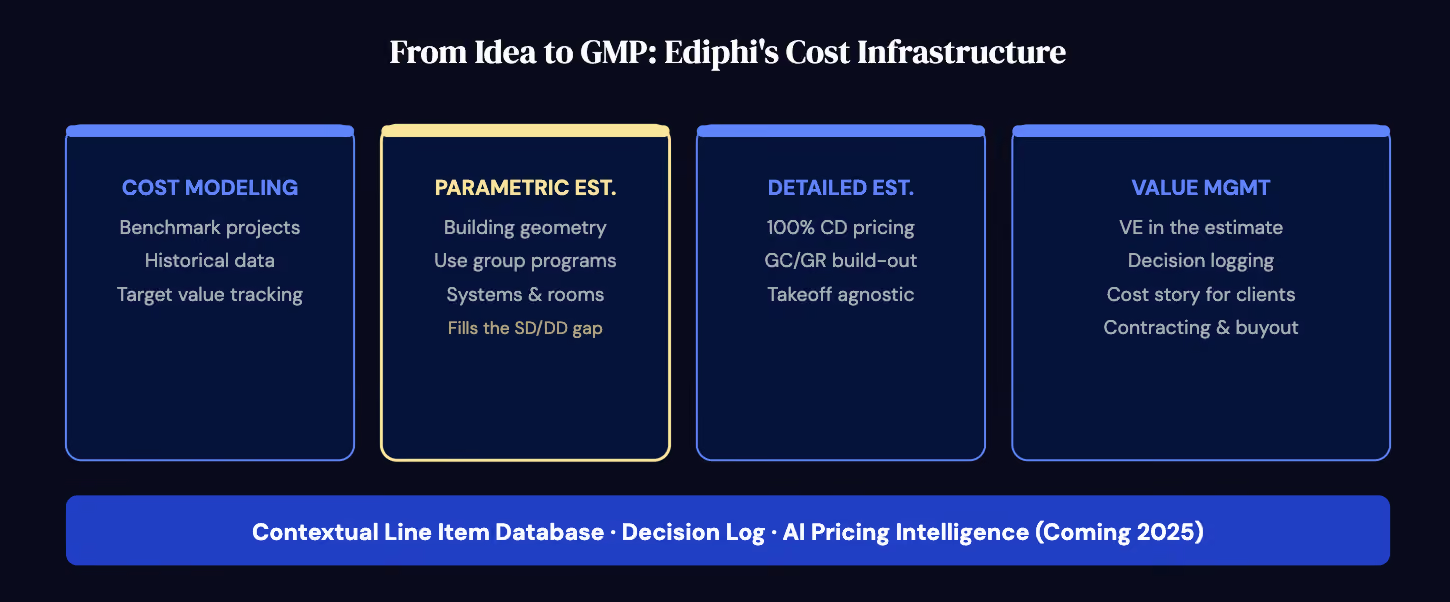
Filling that gap requires parametric and programmatic estimating: defining building geometry, use groups, room types, and area — and using those inputs to generate a high-fidelity cost model at the same time design is happening, not after.
How Ediphi Builds the Infrastructure
Ediphi's approach starts with the geometry of a project: the massing of buildings, the mix of use groups (apartments above retail, below-grade parking, amenities), the floor-to-floor heights, and facade areas. From that geometry, Ediphi generates a cost model linked directly to the company's historical line-item database.
Every line item carries contextual memory. When an estimator prices acoustical ceiling tile for a retail project in a specific geography, Ediphi stores that cost with its context: the project type, the quantity, the date. The next time a similar job comes through, the estimator can see how that same line item has been priced across comparable projects — not a static database cost, but a live record of what the organization has actually done.
"You can see how other people in your organization have used it for different types of projects. The cost is tracked contextually — not as a static number, but as a living record of decisions your team has made."
Dustin Devan, Founder & CEO, Ediphi
The platform also brings value engineering into the estimating workflow — not as a separate process, but as a layer that records every cost-affecting decision throughout the design timeline. That decision log becomes the raw material for the cost story a GC tells their client: not just what things cost today, but why, and how the number got there.
What Pricing Intelligence Actually Looks Like
The cost infrastructure Ediphi is building isn't the end goal. It's the prerequisite for what comes next: pricing intelligence tools that suggest unit costs for specific scopes in specific contexts, surface value engineering options drawn from past decisions on similar projects, and flag what an estimate might be missing before an ops team inherits a gap nobody budgeted for.
Devan was candid about where that work stands. The current version stores the decisions. The next version learns from them. A Series B raise planned for Q3 will fund the integrations and model development to get there.
But he was equally clear that the data layer has to exist before any of that is possible. "Layering on AI until you have cost infrastructure is not going to solve the problem," he said. The morphine doesn't work if you never take out the bullet.
The Role Reversal Worth Working Toward
The most pointed part of Devan's talk wasn't about software. It was about a relationship dynamic in the industry that everyone in the room recognized but rarely names directly: owners design first, then find out what it costs. That sequence, he argued, is backward.
"I want every GC in this room to be the first call an owner makes — because you understand the cost of construction. You can inform them on how to build their program. That's a role reversal we should be pushing toward."
Dustin Devan, Founder & CEO, Ediphi
When a GC can respond quickly with real data, speak to cost drivers before the design team does, and justify the reasons why with a clear cost narrative — that GC becomes a trusted partner rather than a budget checkpoint. Ediphi's goal, Devan said, is to give pre-construction teams the tools to claim that seat at the table.
About Ediphi
Ediphi is a venture-backed pre-construction platform founded in 2023 by Dustin Devan, who previously founded Building Connected (acquired by Autodesk for $275M in 2019). Ediphi serves more than 75 customers including five of the ENR Top 20 general contractors. The platform covers cost modeling, parametric and programmatic estimating, detailed cost estimating, GC/GR, and value management — all on a unified data architecture designed to make construction organizations smarter over time.


