

Everyone in construction has an opinion on hard bid versus negotiated work. Some say hard bid keeps everyone honest. Others say it starts a race to the bottom. Some say negotiated work builds trust. Others worry it removes competitive tension.
Most of that debate assumes one method has to be better than the other. A more useful question is not which method wins, but better for what? Better for price certainty, for speed, for quality, for trust, or for owner outcomes. Those are different goals, and they rarely point to the same answer.
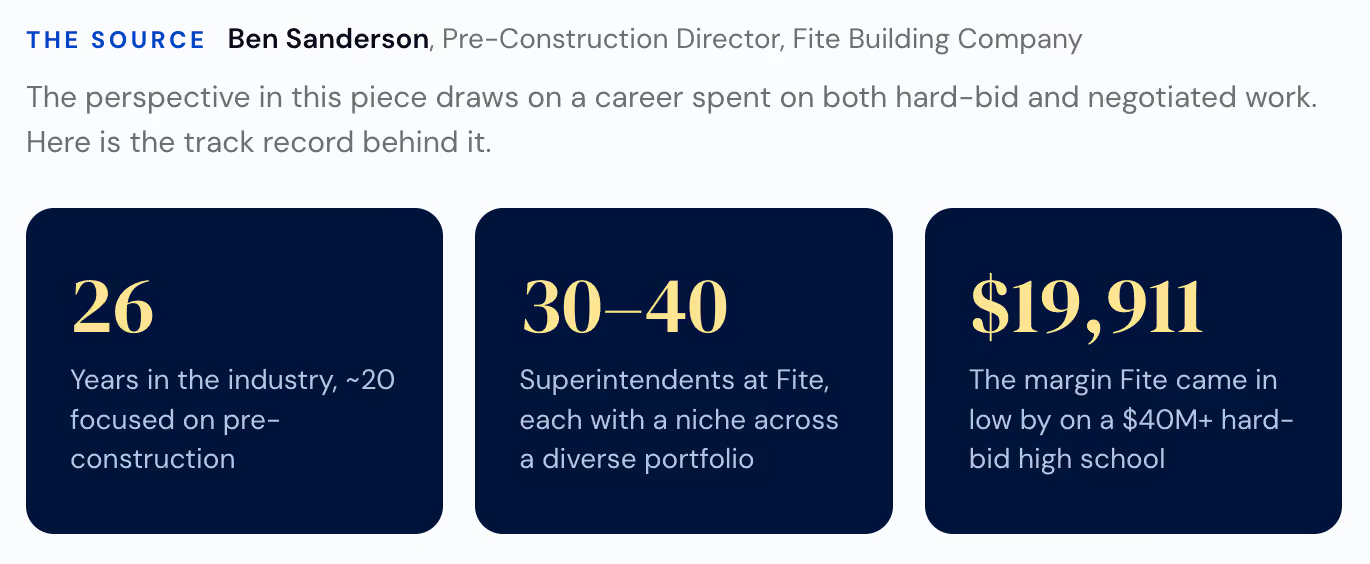
To ground the trade-offs, it helps to hear from a builder who has worked both sides of the line. Ben Sanderson, Pre-Construction Director at Fite Building Company, has 26 years in the industry and roughly 20 of them focused on pre-construction. Fite has run the full range: from a pure hard-bid, zero-negotiated shop early on, to a portfolio that has been around 80% negotiated for much of the past decade and a half, with one foot kept firmly in the hard-bid market.
What "hard bid" actually means on the ground
The phrase gets used loosely, so Ben defined it in Fite's world: typically a public municipality or school system, a two o'clock rip-and-read scenario, a set of what should be complete CD documents, and sometimes three weeks to build a price. The GC casts a wide net to the subcontractor and vendor market, often meeting subs and vendors they have never worked with before.
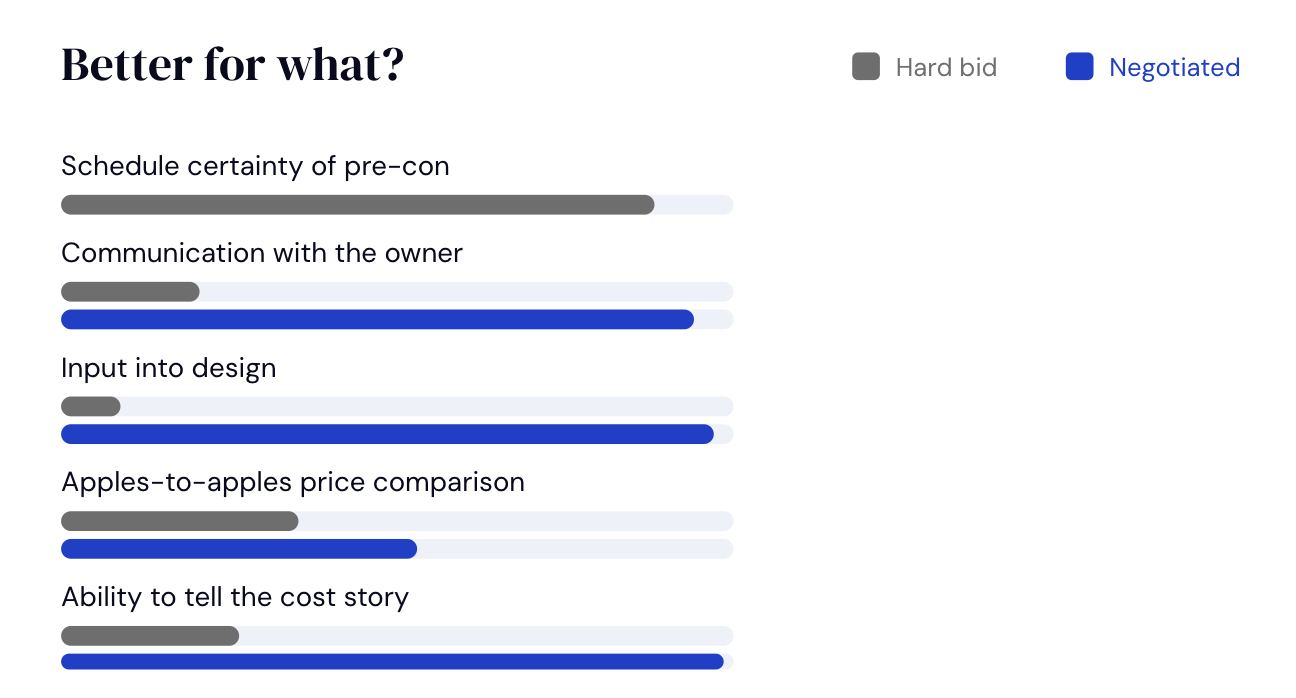
That structure has an edge and a cost. On the plus side, Fite has picked up genuinely good subs and vendors by casting that wide net. On the other side, the GC gets no input into the design and no full read on the owner's programming or intent. All you can price is what you perceive from the documents.
“That type of delivery method really creates an adversarial relationship right out of the gate. And you can't have a project run smoothly and finish on time if it's adversarial from the start.”
Ben Sanderson, Pre-Construction Director, Fite Building Company
The deeper issue is communication. In a hard bid, there is close to zero direct contact between contractor and owner. Questions route through the architect, who has to field them from multiple GCs at arm's length and answer diplomatically. Miss the RFI cutoff and you are pricing off drawings, specs, and your own experience filling the gaps. Two GCs can price the same job and carry different assumptions, which means the owner rarely gets a true apples-to-apples comparison. What actually covers a 5% delta between bidders can be invisible.
A good hard-bid process, when it works
Fite treats even a hard bid as a team sport. Documents come in, a bid team assembles, trades get spread across the pre-con department, APMs, and the project managers likely to run the job, so the eventual handoff to project management is not cold. From there it is quality takeoff, mapping the gray areas between sub trades, and building a pre-con schedule that tests whether the owner's stated duration can actually be beaten.
A recent Fite project shows what a strong hard bid looks like: a local high school, a multi-prime contract through a CM, just over $40 million for the general works package alone, with a storm shelter, a challenging site, 13 addenda inside a two-and-a-half-week window, and three alternates that each touched every trade. Fite won it, low by $19,911 on the bid tab.
Two things made that win feel like a win beyond the number. First, the bid team: interns, assistant PMs, and project managers all in the room, which is how Fite builds future builders and gets people interested in pre-con for the first time. Second, the software. Fite had switched to Ediphi that November or December, and the person driving the estimate that day had never built a full estimate in the platform. He moved between base bid, three alternates, and tax breakouts in one window, under a hard pencils-down deadline. His verdict afterward: he did not think switching would be that simple.
“I can build an estimate so quick, then set it aside and focus on the conversation I need to have with that electrician or that mason. The speed lets us flush out the gray areas and actually find a competitive edge.”
Ben Sanderson, Pre-Construction Director, Fite Building Company
The case for negotiated work
On the other side, negotiated work usually starts with a conversation and an idea. Design-build, or design-build assist where the owner holds the architect but brings the GC into the initial design meetings. Either way, the contractor hears the owner's intent and the designer's intent, understands why the documents took the direction they did, and has skin in the game. If a gray area gets overlooked, the responsibility sits with the contractor, not the owner.
Transparency runs deep here. On design-build and design-build assist, the fee gets negotiated up front and protected, and the owner sees all the way to the back page of the estimate. The job then becomes getting the best price with qualified subs, vendors, and products, chosen for a building that stands the test of time. It is common for owners to call 15 years out asking a contractor to dust off the drawings, which is what a relationship earns long after the final CO.
The trade partner point most people skip
Negotiated work does not necessarily get you "better" trade partners. It gets you the ones who want to walk the process with the owner and explain how a decision moves time, money, and the end goal. Plenty of excellent subs are plan-and-spec builders only, and that is their craft. Different DNA, different fit.
Where negotiated work breaks down
Negotiated is not automatically the answer. The risk is simple: make a commitment to an owner you cannot deliver on. A GC is always in competition, sometimes against another firm, sometimes against its own promises. Budgets get battled. And the pre-con seat is rarely the bearer of good news.
One counterexample proves the rule. Fite turned in a negotiated project and came in under budget, a rare enough result that Ben called it "finding a unicorn." The reason it worked: the owner had two construction people internally who set realistic expectations up front. When an owner knows what a building should cost, the whole negotiation changes.
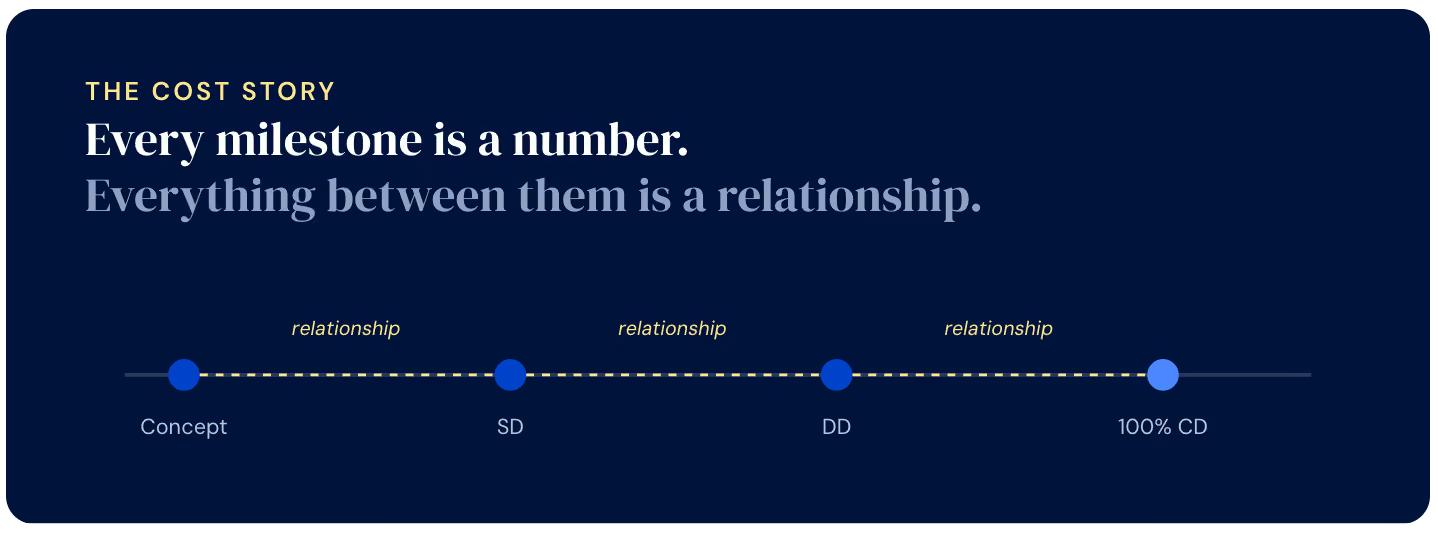
The tool that keeps negotiated work honest is the ability to show your work. When a budget moves from $5M at concept to $7M at CD, "we're sorry, it's seven now" is not an answer. Fite breaks the change down line by line, section by section, through the WBS codes, and explains what drove every cost overrun or drop. As the owner's agent, that explanation is the job.
The real issue is process, not procurement
This is where the real answer sits. You can run a bad negotiated process and a thoughtful hard-bid process. A clever GC can win in a competitive environment, and a negotiated job can still suffer from poor communication and no cost discipline. So the sharper question is not which method is better. It is what creates the right behavior for this project.
Sometimes owners want the behavior of negotiated work with the pricing structure of a hard bid, then get frustrated by the change orders that structure produces. The common thread is communication. Even on select-bid work, distributing RFIs and answers to every bidder keeps everyone on the same field. When a contractor finds a better way to build something, sharing it openly keeps the competition on merit rather than on an information gap.
“Pre-con is the tip of the spear. We're not the ones who build the buildings. We're here to set the field guys up to be successful.”
Ben Sanderson, Pre-Construction Director, Fite Building Company
That through-line holds across every delivery method. People are the value. Process is how you deliver it. Technology is the bridge that makes both better, which is why tech comes last. Modern, cloud-based estimating lets a pre-con lead build an estimate fast, set it aside, and spend the freed time on the conversations that flush out the gray areas, instead of sitting at the office until midnight digging through a database.
Five things worth remembering
- Why hard bid earns a bad reputation
Low price, missing scope. - When negotiated work actually works
When communication runs across the entire team. - The biggest mistake owners make selecting a GC
Choosing solely on price. - What separates the best pre-construction teams
Processes in place for whatever delivery method shows up. - The one procurement change worth making
Rethink the GMP.
The takeaway
Hard bid and negotiated are not good versus bad. Each fits certain situations depending on what the owner is buying, how much time exists, and how sophisticated the owner is. Neither one hands you better information by default, because assumptions and qualifications get made either way. What separates the projects that work is a pre-con team that can explain not just where the number landed, but why it moved. Do that well, and the choice of procurement method matters a lot less than the process behind it.
The number gets you in the room. The story earns the trust.
Ediphi is a cloud-based pre-construction platform for conceptual through detailed estimating, bid leveling, and cost modeling with your own historical data. Stitch the cost story together and make every milestone a conversation.


